
Watch or listen:
Vodcast | Podcast
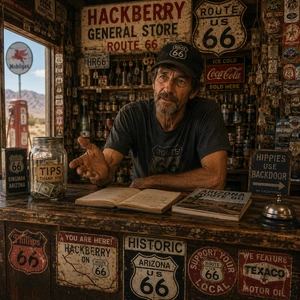
The Man Who Was the Building didn’t introduce himself. He didn’t need to. You understood who he was the moment you walked through the door at Hackberry General Store and saw him moving behind the counter with the quiet ease of someone who had been doing this long enough that the place and the person had become the same thing.
Mary and I had stopped in on one of those Route 66 afternoons where the plan is loose and the road is doing the deciding. Hackberry sits out there on the old alignment like it never got the memo that the bypass was supposed to finish it off. It’s still there. Still open. Still somehow exactly what it always was. And behind the counter so was he.
Older. The kind of older that doesn’t announce itself but settles into a person like the desert settles into everything out here. Unhurried. Present. Tending to the customers the way a good man tends to things that matter to him.
The Man Who Was the Building Didn’t Need a Common Language
A group came in while we were there. Tourists, clearly, from somewhere far enough away that English wasn’t the first thing they reached for. They looked around the way people look around when they’re not quite sure of the protocol. A little uncertain. A little outside their element.
He didn’t hesitate. Didn’t look for someone else to handle it. Didn’t slow down or speed up or change his expression. He just moved toward them the way he moved toward everyone else and started doing what he did. Pointing. Nodding. Smiling the specific smile of a man who has learned that kindness doesn’t actually require words to travel.
They understood him perfectly. Because that’s the thing about genuine welcome. It doesn’t have an accent.
I watched that and thought about every diner I’ve ever sat in on this road. Every counter stool. Every cup of coffee that arrived without being asked for because somebody was paying attention. The best ones always have a version of this man in them. The one who has been there so long and cared so consistently that the building would feel different without him. Not just empty. Wrong. Like something essential had been removed.
The Man Who Was the Building and What Route 66 Keeps Teaching Me
I’ve been driving this road long enough to know that the highway itself is not really the point. The road is just the thread. What it connects is the point. The towns. The diners. The general stores and the gas stations and the trading posts hanging on at the edge of the map. And the people inside them who decided a long time ago that this place was worth showing up for every single day.
That decision is Route 66. Not the asphalt. Not the shields on the telephone poles. The decision to stay and serve and keep the door open one more day.
Hackberry made that decision. So did Seligman. So did Peach Springs and Truxton and a dozen other towns I’ve covered on the Arizona Route 66 Podcast that had every reason to fold and chose not to. The towns that refused to die didn’t survive on their own. They survived because somebody inside them refused to leave. Refused to stop caring. Refused to let the bypass have the last word.
He was that somebody for Hackberry. Or at least he was that somebody on the afternoon Mary and I walked in. Maybe he’s been that somebody for decades. It felt that way.
What the Counter Looks Like From Both Sides
I write Roadside Notes from the stool. The stories come from the people I meet when I pull off the highway and sit down and pay attention. Recently, Pete from Kentucky figuring out patience one breakdown at a time. Jacob wanting to understand everything about tires. Terry holding herself together in a waiting room in Kingman. The Centennial Seekers showing up on Route 66 in its hundredth year looking for something they can’t quite name yet.
Those are counter stool stories. I’m the one listening.
But watching this man work I understood something I’ve been trying to put words to for a while now. The counter looks completely different from the other side. From behind it you see everything. Who came in alone. Who’s been crying. Who needs the coffee refilled but really needs someone to notice them. Who walked in speaking a language nobody else in the room understands and just needs someone to meet them where they are without making it complicated.
The man at Hackberry knew all of that without knowing he knew it. It had become instinct. The way showing up for people becomes instinct when you do it long enough and mean it enough.
That’s what this road keeps teaching me. In the diners and the general stores and the tire shops and the gas stations. In every place where an ordinary person decided to be present and useful and kind without waiting for a reason or an audience or a return on the investment.
That’s Roadside Notes. That’s Route 66. That’s the whole thing right there behind a counter in Hackberry on a loose afternoon when the road was doing the deciding.
If this road is calling you the way it calls me, I’d love for you to pull up a stool on Substack. Roadside Notes publishes every Thursday at roadsidenotes.substack.com where the counter stool stories live. And when I step behind the counter to share what I’m still working out myself, that’s Still Pouring, also on Substack, always free, no paywall, no pitch. And, If Arizona Route 66 has been whispering your name, come find out what this state has to offer at ArizonaPodcast.com. The towns are still out there. The doors are still open. Pull over anytime.
✨ Roadside Reflection:
The Man Who Was the Building didn’t know Mary and I were watching. He was just doing what he always does, which is exactly the point. The best version of any of us isn’t the one we perform when someone’s paying attention. It’s the one that shows up on an ordinary Tuesday and tends to things that matter without needing anyone to notice. Route 66 is full of people like that if you slow down enough to see them.
The towns that refused to die are full of them. They’re not famous. They’re not trying to be. They just keep the door open and the coffee warm and make room for whoever walks in, whatever language they speak, whatever they’re carrying. That’s the whole job. And some people have been doing it so long and so well that you can’t tell where they end and the place begins. If you ever find yourself in Hackberry, pull over. Walk in. You’ll know him when you see him.
Return to Journal |
Listen to The Man Who Was the Building Podcast |
Watch The Man Who Was the Building on YouTube
Faith and Good Courage is a podcast and journal by Christopher Tuttle.