
Watch or listen:
Vodcast | Podcast
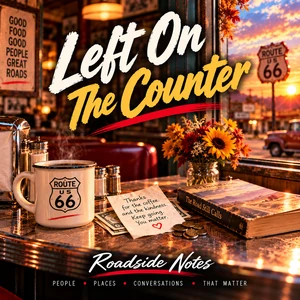
Left on the Counter doesn’t always look like much. A tip that was a little more generous than it needed to be. A paperback with a name written on the inside cover and a note that said take this, it’s worth it. A coffee mug somebody left behind that the waitress keeps on the shelf because it feels wrong to throw it away. Small things. Ordinary things. Things people set down without knowing they were leaving anything at all.
I’ve been paying attention to what gets left on counters for a long time now. Not the things people forget. The things they leave on purpose even when they don’t know they’re doing it on purpose. The residue of a person after they’ve paid up and walked out the door.
It tells you more about someone than most conversations do.
Left on the Counter and the Things Worth More Than the Bill
I watched a man leave a diner one morning outside of Seligman. Older. Work boots. The kind of hands that have been useful their whole life. He paid his check and left his tip and then he did something I almost missed. He folded a piece of paper and tucked it under the edge of the sugar caddy where the waitress would find it after he was gone.
I don’t know what was on it. That’s not the point. The point is he took the time. He thought about her enough to write something down and leave it where she’d find it. He was gone before she ever picked it up.
That’s the best kind of left on the counter. The kind that arrives after you’ve already left. The kind where you don’t get to see the reaction because you weren’t there for the reaction. You did it because it needed doing and that was enough.
She picked it up about ten minutes later. Read it. Set it down. Looked out the window at the parking lot for a second like she was looking for whoever left it even though she knew they were long gone. Then she folded it carefully and put it in her apron pocket.
I finished my coffee and didn’t ask.
Left on the Counter Is How Some People Say What They Can’t Say Out Loud
There’s a version of kindness that needs an audience. That needs the thank you and the eye contact and the confirmation that it landed. That version is fine. It’s still kindness. But it has a cost attached to it even when nobody’s keeping score.
Then there’s the version that happens after you’ve already left the building. The note under the sugar caddy. The book on the seat. The tip that’s too generous for what the meal cost because you wanted to leave something behind that said this mattered even though you’ll never be back to say it in person.
That version costs nothing except the willingness to think about someone else for thirty extra seconds before you walk out the door. And it follows people home in a way that the face to face version almost never does. Because they find it after you’re gone. When the room is quieter. When there’s space to actually feel it.
I’ve been trying to leave more things on counters. Not because I’ll know what happens to them. Because that’s exactly the point. You leave it. You go. Whatever it does after that belongs to the person who finds it.
That’s enough. It always has been.
✨ Roadside Reflection:
Left on the Counter is not about the object. It’s about the decision to leave something behind for someone you may never see again. The note. The book. The tip that said your time mattered to me even if I never said it out loud. Every counter on Route 66 has something on it right now that somebody left behind without knowing how long it would stay or what it would mean to the person who found it.
You get to add to that today. It doesn’t have to be big. It just has to be intentional. Leave something worth finding. Then walk out the door and let it do what it’s going to do. The best things you ever leave behind are the ones you’re not there to see land.
Return to Journal |
Listen to the Left on the Counter Podcast |
Watch the Left on the Counter on YouTube
Faith and Good Courage is a podcast and journal by Christopher Tuttle.